Featured books:
When Things Start to Think
The Elegant Universe
Q is for Quantum
Of Flies, Mice and Men
Calculus: The Streetwise Guide
The Mummies of Urumchi
|
Return to the BookStore
|
"When Things Start to Think" |
Purchase this book online:
When Things Start to Think
by Neil Gershenfeld
 |
|
Synopsis: |
When our shoes, telephones, and books start to think, what
will they think about? And will they be any fun at parties?
Neil Gershenfeld, director of the Physics and Media Group at
MIT's Media Lab, examines the ways our everyday lives will
be affected by intelligent machines, from electronic books
to smart money, in "When Things Start to Think."
|
| One reader said: |
|
A good book for discovering about the future directions of computer science and the things which will be
coming our way some day soon from research done at the Massachusetts Institute of Technology. Dr.
Gershenfeld writes very good explanations for some very advanced research topics and their future uses.
Covers a revolutionary invention known as electrophoretic paper for making an electronic book which looks
exactly like a book but whose pages have the properties of a computer monitor.
|
|
Purchase this book online:
The Elegant Universe: Superstrings, Hidden Dimensions, and
the Quest for the Ultimate Theory
by Brian Greene
|
|
Synopsis: |
The hunt for a theory of everything is an esoteric pursuit,
yet mathematicians and physicists all over the world are
working feverishly to try to resolve the difficult conflicts
between general relativity and quantum theory. In "The
Elegant Universe: Superstrings, Hidden Dimensions, and the
Quest for the Ultimate Theory," physicist Brian Greene
eloquently relates the scientists' stories as well as
evidence that everything in the universe rides on
unimaginably tiny loops of pure energy.
|
| One reader said: |
|
String theory opens up the possibility that there are at least 6 extra, hidden dimensions wrapped up by almost
infinitely tiny strings, an almost mystically complex solution to the fundamental incompatibility of quantum
mechanics and relativity. Brian Greene, a physicist with a light touch, brings string theory down to earth in a
book substantially easier to read than A Brief History of Time. If, as seems likely, string theory becomes a
dominant theme (and a dominant metaphor) of the 21st century, The Elegant Universe may well be the book
which opens it to the general public.
|
|
Purchase this book online:
Q Is for Quantum
by John Gribbin
|
|
Synopsis: |
The inimitable John Gribbin takes you on a tour of the
universe in "Q Is for Quantum," a cross-linked encyclopedia
of everything, by way of the esoteric study of particle
physics.
|
| One reader said: |
For all you Douglas Adams fans out there ( The HitchHiker's Guide to the Galaxy) we have now got
definitive, non-fictional guides to the Cosmos and the micro-world of Quantum Phenomena.
John Gribbin's latest book "Q is for Quantum" is the perfect companion to his 1996 masterpiece "Companion
to the Cosmos".
Gribbin's presents his work in a well illustrated, encyclopaedic (A to Z) style with nearly all topics having
hyperlinks to cross-references elsewhere in the book. He puts great emphasis on the human dimension of
science as well as on the purely physical phenomena and theories he describes so well. The mini-biographies
of the scientists are fascinating in their own right, particularly when looking at the historical context and the
geographic, social and academic connections/parallels that have led to these great advances in human thought.
Gribbin guides us along those amazing scientific paths of the past half millennia , from Galileo and Newton
to Einstein and Hawking. He has this reader convinced that we are very close to realizing the ultimate dream
of a Grand Unifying Theory (GUT) which ties together all the links between the forces of nature. His work is
right up to date and includes the latest ideas on M-branes and superstrings.
The best way to read the book is to open it at random , find a topic of interest and see how far the hyperlinks
can take you. Bliss for a net-head! The real strength of Gribbin's writing is to help us cover that great
spectrum (in time and space) between the sub-atomic microworld of Quantum phenomena through to the
edges of the Cosmos. Somewhere in the middle is the human dimension, dare I say, the 'real world'.
It was our friend Douglas Adams who posed that trickiest of tri-lemmas ... What is the answer to that ultimate
question, that is, the Meaning of Life, the Universe and Everything ? He told us � it is 42 !
John Gribbin's agrees - look up his section on Planck. What is the smallest unit of time? Answer: zero,
decimal point, FOURTY TWO zeros, one second.
Before Planck time nothing much happened ... but then again ...
|
|
Purchase this book online:
Of Flies, Mice & Men
by Francois Jacob
|
|
Synopsis: |
"Of Flies, Mice & Men" tells the story of modern biology in
seven elegant essays. Geneticist and Nobel laureate Francois
Jacob outlines the research that led to genetic engineering
and takes a look at the human side of science.
|
| One reader said: |
|
Molecular biology seems to crystallize our feelings about science. The promises and threats of knowledge are
made plain as we peek around the corner and see genetic counseling, genome mapping, and cloning staring
back at us. Pioneering researcher Fran�ois Jacob--who shared the 1965 Nobel Prize for medicine--offers his
thoughts on the past, present, and future of science in Of Flies, Mice & Men. As informal as a memoir, yet
sharp and clever in its discussions of philosophy and politics, Jacob's book breaks new ground in
popular-science publishing.
|
|
|
"How to Ace Calculus: The Streetwise Guide" |
Purchase this book online:
How to Ace Calculus: The Streetwise Guide
by Joel Hass, Abigail Thompson, and Colin Adams
|
|
Synopsis: |
Whether you're a student, a teacher, or simply an
enthusiastic mathphile, "How to Ace Calculus" has the
indispensable lowdown on this most feared subject.
|
| One reader said: |
|
If you are going to take any classes in calculus, this is the book to have to help you along. The authors put
formulas and theoretical ideas that are definitely intimidating and down right scary into simple words with
some very funny examples. It covers from how to approach your professor to what most likely will be
covered on any test or exam you may encounter. This book is definitely a lifesaver when teachers fail to
spend enough time on the theoretical ideas of calculus. The book is also well-laid out and flows from one
topic to another in an order in which they relate to each other. This book helped me ace calculus and it will
definitely help anyone struggling with calculus.
|
|
Purchase this book online:
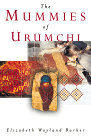
The Mummies of Urumchi
by Elizabeth Wayland Barber
|
|
Synopsis: |
If you read one mummy book this year, let it be "The Mummies
of Urumchi." Elizabeth Wayland Barber takes a fascinating,
detailed look at these enigmatic, 2,000-year-old Caucasians
whose remains, clad in gorgeously colorful clothing, were
found in central Asia.
|
| One reader said: |
|
These mummies, although almost 4,000 years old, are almost as alive as they once were in the mighty
vastness of China's ancient deserts. Anglo faces in an oriental land, makers of colorful and intricate wool
clothing (AND Tartan Plaids!), people who knew the art of mummifying with sand, wood and salt to a
degree even greater than the Egyptians -- this book gives a lavish presentation of a newly unearthed and
fascinating mystery. Makes me want to hop the next plane/Land Rover/camel to this ancient and inhospitable
land to view the beauty and mystery given up so recently by the desert sands.
|
|
|
